When homeowners think about upgrading their kitchen walls, the conversation almost always starts with the splashback. Tiles, glass, stone. But the splashback is only a small portion of the kitchen wall space. The dining wall, the island front, the end panel next to the fridge, the wall above a banquette. These are the surfaces that define the feel of the kitchen, and they are almost always left as flat painted plasterboard.
Textured embossed panels change that. They give kitchens a material quality that paint alone cannot deliver. Real three-dimensional texture you can see and feel, embossed on the Gold Coast from MDF, plywood, veneer, or solid timber.
Where embossed panels work in a kitchen
The key is knowing where to use them and where not to. Embossed panels are not a splashback replacement. They are not designed for direct heat exposure or constant water contact. That is what your tiles, glass, or stone are for.
Embossed panels work on every other wall in the kitchen. Here are the five most popular placements.
1. The dining wall
If your kitchen has a dining area along one wall, that wall is the single best candidate for embossed panels. It faces the kitchen, catches the eye from the main living area, and is far enough from the cooktop to avoid heat and moisture concerns.
Run the panels floor to ceiling for maximum impact. In an open-plan kitchen-living space, this wall becomes the anchor that defines the kitchen zone without needing a physical divider.
2. Kitchen island end panels
The island is usually the largest visible surface in a modern kitchen. Most islands have flat panel ends in white or matching cabinetry. Replacing those end panels with embossed texture immediately elevates the whole room.
This is a small surface area (typically one or two panels), so the cost is modest and the installation is straightforward. American Oak is the most popular choice here because the timber grain complements stone and laminate benchtops naturally.
3. Breakfast nook or banquette wall
If you have a built-in bench seat or a breakfast nook, the wall behind it is perfect for embossed panels. The seating zone needs warmth and character, and textured panels deliver both. Paint them to match or contrast the bench upholstery.
4. The wall above upper cabinetry
In kitchens with upper cabinets that do not reach the ceiling, the gap between the top of the cabinets and the ceiling is often left as dead space. Embossed panels in this zone add a visual finish that makes the kitchen feel complete rather than builder-grade.
5. The wall opposite the bench
In galley kitchens or U-shaped layouts, the wall opposite the main benchtop is often visible from the living area. A full-height run of embossed panels on this wall creates a feature that draws the eye and gives the kitchen a designed, intentional look.
Keep embossed panels away from direct heat sources and areas that receive constant water exposure. Behind the stove and directly beside the sink are splashback zones. Everything else is fair game.
Best patterns for kitchens
Kitchen feature walls benefit from patterns that complement the strong horizontal lines already present in benchtops, cabinetry, and shelving. Here are the top three for kitchen applications.

American Oak gives your kitchen the warmth of natural timber cladding without the cost or upkeep. The long grain lines complement the horizontal lines of benchtops and shelving, creating a layered, cohesive look.
Paint it in a warm white to match modern cabinetry, or stain it in a natural timber tone for a Scandinavian-inspired kitchen. Either way, it feels like the kitchen was designed around the wall rather than the wall being an afterthought.

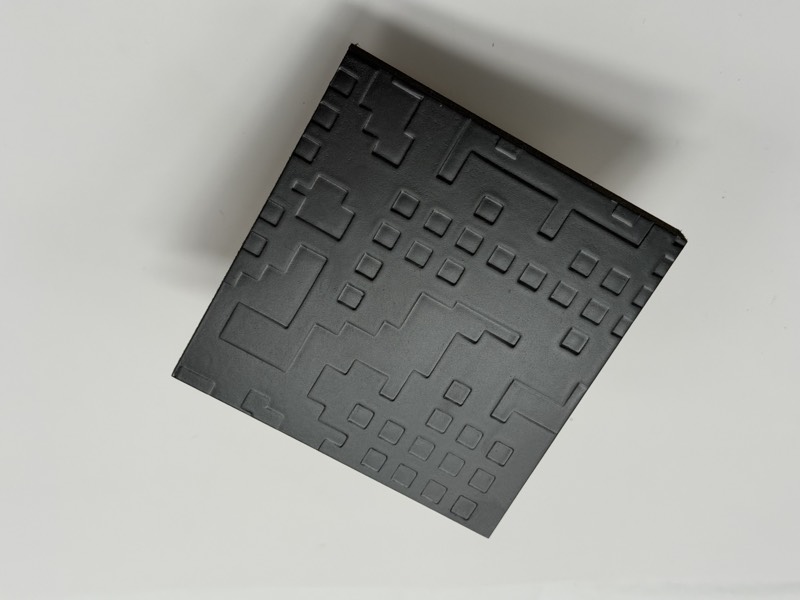
Matrix is the pattern for kitchens that are already minimal and modern. The geometric grid adds visual interest without introducing competing organic shapes. It pairs well with flat-panel cabinetry, concrete benchtops, and integrated handles.
In a white or light grey, Matrix reads as architectural. In a darker tone, it creates a graphic backdrop that makes the island and cabinetry pop forward.

Rough Cut suits kitchens that lean toward an industrial, farmhouse, or rustic-modern aesthetic. The deep, textured surface mimics raw sawn timber and pairs naturally with open shelving, exposed brick, and timber benchtops.
It is particularly effective on the dining wall of a kitchen-living space where the kitchen needs to feel less sterile and more like a room you actually want to spend time in.
See the texture before you renovate
Request free coaster samples of up to three patterns. You only pay $25 flat rate postage.
Request Free SamplesFinish and colour for kitchen panels
Kitchens have more moisture and cooking steam than bedrooms or living rooms, so finish matters. Here is what works best.
- Semi-gloss or satin paint is the recommended finish for kitchen panels. It is easier to wipe down than matte, resists moisture better, and gives the embossed texture a slight sheen that catches kitchen lighting effectively.
- White and off-white remain the most popular colours for kitchen panels because they work with every cabinetry colour and do not compete with benchtop materials.
- Dark accents (charcoal, navy, deep green) work well on feature walls that are visible from the living area. The dark colour adds depth to the open-plan space and the embossed texture prevents it from feeling like a flat dark void.
- Timber tones applied as a stain or timber-look paint system give the panels a natural timber appearance at a fraction of solid timber cost.
Preview your colour choice using the M-Bossed AI Colour Studio before you commit. Upload a photo of your kitchen and test different patterns and colours on your actual walls.
Kitchen panels vs other wall options
Homeowners upgrading their kitchen walls typically consider three options: wallpaper, VJ panels, or embossed panels. Here is how they compare.
- Wallpaper gives you pattern and colour but zero texture. It can peel in humid kitchen environments and is difficult to repair once damaged. You also cannot repaint it if you change your colour scheme.
- VJ panels add a traditional cladding look but the texture is purely groove-based. They suit heritage and Hamptons styles but do not offer the range of patterns or the depth of texture that embossed panels deliver.
- Embossed panels combine real three-dimensional texture with full colour flexibility. They are more durable than wallpaper, more versatile than VJ, and can be repainted whenever you update your kitchen scheme.
For a detailed comparison of embossed panels versus other wall treatments, see our embossed vs natural timber comparison.
Sizing and installation
M-Bossed panels are cut to your exact wall dimensions at no extra cutting charge. Measure the wall, tell us the width and height, and the panels arrive ready to install.
Installation follows the same process as any other room: construction adhesive plus pin nails, then fill, sand, and paint. In a kitchen, pay extra attention to the paint finish (semi-gloss or satin) and make sure the panels are not positioned where they will receive direct water from the sink.
Allow 5 to 7 business days for production and delivery. Panels are embossed on the Gold Coast and ship Australia-wide. If your renovation has a fixed timeline, get in touch early to lock in your production slot.
Start with samples
The best way to choose a pattern for your kitchen is to see the samples alongside your benchtop, cabinetry, and flooring. Order free coaster samples of up to three patterns (you pay $25 flat rate postage) and hold them against your kitchen walls under your actual lighting.
The pattern that disappears into the room while still adding texture is usually the right one. Kitchens already have a lot going on visually. The feature wall should elevate the space, not compete with it. For a complete guide to all six patterns, see our pattern selection guide.